Thursday, December 3, 2009

Corporate Responsibility

“In almost any gift-giving situation, there is some expectation of return, whether is it a tax deduction, a named building, or an enhanced reputation. That’s why anonymous gift giving is so rare. Giving always occurs within a social context that makes a gift reciprocal in nature. Perhaps corporations that give with some expectation of return are only being more strategic and explicit than predecessors who gave with equal expectations but said less about it - or who gave without planning. For a gift to be genuinely altruistic in nature, that is, for it to demonstrate other-centered love, it must have benefit to the recipient as its primary motive and purpose, but not necessarily its only motivation or purpose. Therefore, strategic or “smart” giving may be regarded as ethical.”
from: Media Ethics: Cases and Moral Reasoning. Christians, Clifford. 2001.

I read over this quote a dozen times and each time I finished reading I felt something different. Disgusted, understanding, confused, angry, annoyed, all of the above.

However it wasn’t until I was walking down Main Street, where stores have already begun decorating for the holiday season and the surrounding trees are lit up I began to feel hopeful. I started to realize that even though companies may benefit from giving, I’m hopeful that, as humans, their primary motivation is to help the recipient.

When I began researching what kind of gifts companies give it only furthered my hope for humanity in the business world.

Giving Companies:

Home Depot- Home Depot donates materials from their stores to Habitat for Humanity to help build homes, employees even volunteer to help with the process.

Below is a video by Habitat for Humanity where Glen Bailey describes the impact of corporate giving:


Exxon/Mobil: Exxon donates large amounts of resources to help protect tigers, their company logo, and their environment.

Coca Cola Company: Coca Cola partners with the World Wildlife Fund to help support polar bears by taking action to reduce human impact on global climate change.

Now, I know that these companies give strategically. Meaning, they expect some return for their donations, whether it’s positive recognition or a tax deduction. However, I have faith that their initial reasoning for giving is to better the recipient and the environment around them.

Strategic giving might sound a bit negative and manipulative, but when you take some time to look at the cause there’s no way the company heads are only in it for their benefit.

Here are some websites that write a little more on the benefits of company philanthropy:

PR Blog
Overtone Communication

Philanthropy as Public Relations:A Critical Perspective on Cause Marketing


^d
Katie Keane


Thursday, November 19, 2009

Orthrus in the 21st Century

The Internet has changed everything. The way people communicate, receive their news, and even how they publish their works. With many new ideas being uploaded daily onto the web, copyright laws become pretty blurred.

Thankfully there is a nonprofit corporation called
Creative Commons that is
Dedicated to making it easier for people to share and build upon the works of others, consistent with the rules of copyright. Creative commons provides free licenses to mark creative work with freedom that the creator wants it to carry, so others can share, remix, use commercially, or any combination thereof.

For PR practitioners there are several advantages to using creative commons license such as:

1. A Promotional Tool

Allowing the work of the company or client to spread quickly throughout the Internet.

Adam Singer wrote “ Creative Commons is smart as it actively encourages sharing with permission and attribution.”

2. A Collaboration tool
I believe the ole saying goes, “Two heads are better than one” creative common licenses allows many more doors to open up to businesses, artists, and other publics all over the world.

In public relations, collaboration is an extremely important tool to understand what a company wants compared to what its public needs. The use of creative common license could be exceptionally helpful in helping both sides.

Jonathan Coulton said, “With creative commons, the act of creation becomes not the end, but the beginning of a creative process that links complete strangers together in collaboration.”

3. A Beneficial tool

Creative Common licenses make it easy and fast for others to find works they might need for research or other projects. To be a good resource towards a public is good for businesses last time I checked.

Molly Kleinman a Copyright Specialist at University of Michigan Library wrote on the Creative Commons site:

“I love Creative Commons because it provides an easy answer to so many difficult questions. So many educators are confused about copyright law and terrified of using copyrighted material because they fear they might be sued for infringement, and it limits what they teach and how they teach it. Now there is a vibrant pool of CC-licensed material to draw from and build on, and it enriches the educational experience for everyone.”

The internet is changing how a lot of people work nowadays, but as the above examples show that doesn’t necessarily have to be a negative thing.

^d
Katie Keane

Thursday, November 12, 2009

how to add a page to your blogger

hey guys heres a step by step process hopefully this will make a little bit more sense: click on the pictures to make them bigger

step 1: create a new post just like you would any entry
-before posting click POST OPTIONS and click on Dont Allow, hide existing
-also change the date of your post to a date previous to your very first post, to make it easy just change the date to 2008 if you want


step 2: return your blogs dashboard and click on LAYOUT


from here click EDIT HTML
Under EDIT TEMPLATE check the box next to EXPAND WIDGET TEMPLATES


to quickly find hit control F or apple F and search for it

once you find it TYPE , dont PASTE BEFORE it


and AFTER it

if you just copy and paste it youll receive and error message!

SAVE!

step 3: click on the SETTINGS tab, click on BASIC


place the following code in your DESCRIPTION box Static Page

you can name the page anything you want, just change STATICPAGE to the name of your choice...like mediakit, etc

you should get something like this as your final look:


i hope this helps!

^d
katie keane

Thursday, October 29, 2009

Time to get 'Linked In'

With nearly hundreds of different online social media tools to choose from it is important for PR practitioners to choose applications that will most benefit their company or organization’s needs.

Online social media has introduced new and exciting ways for people to connect, build, and maintain relationships. So it is in a PR practitioner’s best interest to join the networks that would grant them the best access to their publics.

So in High Fidelity style here they are, the top 5 online services PR professionals should be using:

1) Twitter
Twitter is a simple way to inform your publics of current news and events from your organization. Twitter has become extremely popular because of its human factor. With only 140 characters you can connect with your “followers” on a personal level. PR practitioners can use Twitter to quickly answer questions, complaints, or concerns that their publics may have.

2) Facebook
Facebook started out as a college networking system has expanded into a social networking site for adults and now businesses. Because Facebook already has millions of users, creating a ‘page’ for your business will give it access to those users. PR practitioners can use this tool to hold contests and offer new promotions.

3) Wordpress
Wordpress is one of the many blogging applications available now. Wordpress, or any blogging site, is a great way to for a company to connect to its internal and external publics.

4) flickr
flickr is a video and photo sharing website is a great way to help a company allow its publics to be interactive. PR practitioners can use this tool to give the company’s publics the opportunity to share images and videos they have as well as see how it interacts with other publics.

5) Delicious
is a social book marking web service that is growing more and more popular. This site allows users access to their bookmarks regardless of what computer they are using as well as share those bookmarks with their networks. PR practitioners should use this application to bookmark company media and to monitor what their publics are finding interesting.


Regardless of the application choice, it is becoming extremely important for businesses and organizations to use these social media outlets. Each tweet, post, or picture is a way to interact with a public and to connect with it on a human level.

The links are there, there's really no excuse not to jump on the bandwagon now.

^d
Katie Keane

Wednesday, October 21, 2009

always wear sunscreen

How a company reacts during a crisis will determine how long the issue will carry on and how much harm or benefit it will cause.

Although PR practitioners don’t “solve” crises, they do play an important role in conveying information on how organizations are solving the crises. There are several things a PR practitioner can do to help solve the crises and prevent further damage. Some of the more important factors include:

1. Plan
    Before a crisis even hits, companies should have a clear and defined plan. The plan should include:
  • Who is in charge- a chain of command that dictates what responsibility belongs to whom.
  • Who has the information- Create a list of the types of information needed and where it will have been stored in anticipation of a crisis.
  • Who will speak on behalf of the organization- Designating a single spokesperson can help to avoid confusion and mistakes when it comes to speaking to the media. The spokesperson should be knowledgeable, composed, careful with words, and confident.
  • Prepare a website-Create a “dark site" that can be launched at any time. Post to the site information the company’s publics would find important and interesting.
2. Promptly inform ALL publics
  • The media will want all the facts and numbers right away. Give them whatever you may have at the time and tell them you will report back with updates as soon as more information becomes available.
  • The employees should not be forgotten in the time of a crisis. They can be a company’s best line of defense and/or offense. Keeping employees informed will keep them from speculating and spreading rumors.
3. Be accessible
  • Although one’s first reaction in a crisis is to run and hide, keeping the media in the dark will only add fuel to the fire. Between a company’s spokesperson and dark site information should be streaming throughout the entire crisis. Accessibility can help to cut down rumor mills that might get started through all the different social networks out there today.

Companies never look forward to a time of crisis. However, when they do occur and a company reacts well, it can come out of the crisis looking better than before the incident occurred.

By following the three steps I outlined above, a company will build trust and a positive reputation with the media, its employees, and its audience.

To build a strong, stable, and positive reputation a company must be strong, stable and positive even during the most critical of times.

^d
Katie Keane

Wednesday, September 30, 2009

Whose Got the Power?

Transmitting information from one entity to another can be done in a variety of ways. Through email, letters, speeches, music, art, and blogs, messages are carried out to numerous publics daily. However, to reach opinion leaders and other key publics PR practitioners use the mass media-radio, television, newspapers, and magazines.

The use of mass media allows information to be spread quickly to millions of people.

Several theories have developed to model the effect of using mass media to inform the public and shape public opinion. Among those theories are the Uses and Gratifications Theory and the Agenda-Setting Hypothesis.

The Uses and Gratifications Theory is really the only model that grants power to individual audience members. This control allows the audience to choose which messages will be received and acted upon. With the audience holding most of the power, the media becomes highly influenced by their wants and needs.

The Agenda-Setting Hypothesis is seen as the most accurate journal by most journalists. The hypothesis doesn’t tell people what to think, but what to think about. The media doesn’t try to persuade its audiences to think one way or another, but most media outlets carry the same top stories, thus the audience is led to consider what is “most important,” no matter where it looks.

Together these theories form a relationship that makes the audience believe that the media is leaving a message their hands. For example, a PR practitioner could use the Uses and Gratifications Theory to send messages to media they know audiences want or need and then use the Agenda-Setting Hypothesis to have several media outlets to carry out the story.

The role of a PR practitioner is essential in both theories. In the Uses and Gratifications Theory they supply information and messages to the media through the public. In the Agenda-Setting Hypothesis PR practitioners are more behind the media, delivering information and messages to the media, who then delivers the message in turn to the public.

Most messages seen or heard can be traced back to a public relations practitioner. It’s quite a powerful trade if you ask me.

^d
Katie Keane

Wednesday, September 23, 2009

This is Our Emergency

America has had a tough decade with terrorist attacks, a war on weapons, and an economic crisis. All of which have caused the American people to question everything and everyone. This doubt has made it extremely difficult for PR practitioners to earn and maintain credibility with their audiences.

I think it’s time that PR practitioners earn back the trust of the American people. A new decade begins in a few months, and with the plan I’ve mapped out below, a new attitude towards pr can begin with it.

GOAL: To increase credibility within the PR profession as a new decade begins by reestablishing relationships and trust with their publics.

OBJECTIVE 1: To increase accreditation programs by 30% among PR practitioners by March, 2011

Tactics:

  • Make accreditation mandatory for all PRSA members
  • Reduce fees, or use fees, to go towards test costs
  • Make available free workshops and study sessions for members
  • Arrange a face-to-face meeting with major and influential businesses to educate them on the benefits of having APR certified employees

OBJECTIVE 2: To increase community outreach by 40% with partner firms and businesses by June, 2012

Tactics:
  • Make community service mandatory for all PRSA members
  • Include the importance of social medias such as Twitter and Facebook in PRSA newsletter
  • Arrange a face-to-face meeting with partner firms and businesses to discuss the importance of community relations and create incentive plans for their employees who become active in the community

A PR practitioner’s job is to influence their publics, and to be influential someone must be seen in a positive light, as trustworthy, and reliable. Succeeding in this plan could be a huge step in showing PR practitioner’s efforts to improve their field and its values.

Growth of the accreditation program would be one of the best ways to increase credibility in the PR field. With set standards and rules, practicing PR practitioners would become more aware and more liable for all of their actions. Certification in the field would allow businesses to be more conscience in who they are hiring as well as create an image to their publics that they are creating the best team possible.

Americans grew up learning to trust the people that entered their homes every night for the 5 o’clock news. PR practitioners have always remained more behind the scenes, strangers to the mass public. Community outreach would allow face-to-face time with the practitioners and the general public, allowing a familiarity to evolve and trust to begin.

This plan could be costly in the beginning, but the benefits of earning the American people's trust back far outweighs that cost.

^d
Katie Keane

Wednesday, September 9, 2009

Fundamentals: The Building Blocks of Fun; Accreditation: The Foundation of Credibility

PR practitioners have been arguing the idea of licensing or accredit ting their profession for decades.

Considered a trade, the field of public relations doesn’t have fixed standards, meaning that education, experience, or state laws have no concrete influence in the profession. And with the notion that anybody could be employed in public relations, it becomes harder to differentiate credibility and legitimacy in practitioners.
David Reich argues that neither licensing nor accreditation would be able to regulate the public relations field successfully. I agree with Reich on licensing, PR is too diverse and dynamic to be successfully regulated by law.

However, I have to disagree with Reich’s argument against accreditation. Outlining set standards to which the profession could be assessed against would increase integrity, value, and marketability with clients, employers and media.

Certification revolves around two elements outlined by
Stuart Bruce that separate qualified PR practitioners, those having broad knowledge, experience, and professional judgment, from the unqualified.
  1. Basic principles and fundamentals, the history and ethics of the profession.
  2. Practice
Image provided by Oscar Nunez

Beth Harte wrote that her process to becoming an accredited PR practitioner was more about the journey than the outcome. Her studies led her to meet and learn from many different PR professionals, which spawned new relationships that opened her to new opportunities and lead to new jobs.

In the public relations world, seeing APR after a name instills standing and experience. In the business world the meaning of those three letters, APR, remains as “annual percentage rate.”

PRSA developed accreditation programs decades ago but has failed to implement a plan to convey the importance of APR to business leaders.
I began brainstorming on a few ideas that could increase the visibility and importance of accreditation to businesses
  1. Communicate how an accredited PR practitioner could benefit a business.
Or yet, share what being an accredited PR practitioner means. CEOs need to realize the intense involvement that goes into receiving certification.

When a practitioner is able to place APR after their name they become accountable to abide by the regulations set forth by the PRSA. Regulations that ensure practitioners to be ethical, courteous, trustworthy and considerate, characteristics any CEO would want in their employees.

Business leaders aren’t the only ones to benefit from having a highly trained and knowledgeable public relations department, the business as a whole would be seen as more reliable.

2. Plan a media outreach tour to spread awareness.


I just recently learned what APR truly means, and being in my third year as a PR student that’s pretty alarming.

PRSA has contacts worldwide that would help in promoting the importance and benefits of becoming APR certified. Through interviews with leading PR practitioners, discussion panels at business conventions, and forums at influential universities, PRSA could open the eyes to many potential employers, clients, and consumers.

image provided by FuseBox Theatre Co.

3. The most extreme option would be to require accreditation in order to practice public relations.
“If we are to be true corporate counselors with a place in the boardroom alongside lawyers and accountants then we need to be as highly trained and regulated as they are.”
-Stuart Bruce

Bruce writes that it is the corporate social responsibility of PR companies to invest back into the business. That means supporting current and new employees to get their accreditation by offering study leave or assisting with course fees.

I couldn’t agree with Bruce more. City governments, hospitals, and the military pay for their employees to go back to school or be retrained, PR companies looking to better qualify and legitimize their organization should show the same willingness.

With the backing from major PR firms, accreditation and PRSA would finally have some teeth in regulating the profession.

Will I become APR certified following my graduation? All arrows point to yes. The process might be time consuming and costly, but PR is something that I love and want to perfect.


^d
Katie Keane

Tuesday, September 1, 2009

I got skills, they're multiplyin'

With unemployment increasing and my graduation date creeping closer my anxiety level has sky rocketed. I sit in my classes surrounded by my competition daily and begin to question what skills my classmates might have that will guarantee them a job instead of me.

I begin to create my resume in my head, listing all the skills I've mastered through the years and the traits I possess. I started to ask myself whether or not they were enough? A simple Internet search would answer this question.

I began my search by using the more popular job search engines: monster.com, hotjobs.com and indeed.com, and found pages full of job openings in the field of public relations.

As I clicked through the listings I started to see similar qualifications and skills that companies were looking for in a potential employee. Five of which stood out as being essentials in the PR world.

1. Outstanding writing skills

In a job listing posted on idealist.org, the California Environmental Associates requested applicants who could “write and edit compelling, impactful documents for a range of audiences.” This would be extremely important in a non-profit organization such as CEA, whose “mission is to help policy-makers and regulators develop and implement policies that will improve the environmental sustainability and economic efficiency of the electric sector.”

With every press release or a speech, PR practitioners must be able to use their writings to captivate their clients or audiences quickly and powerfully.

Good grammar and spelling are key factors as well because they show professionalism and that a company can be taken seriously.

2. Building Relationships

Whether it’s a relationship with a client, a co-worker, the media, or a source, a PR practitioner’s relationship skills can either make or break a company or organization.

Just Harvest posted applicants must a) have experience with media relations and b) have a proven ability to work effectively in a team.

Similarily, California Council for Humanities post on the idealist.org requires someone who has “experience managing and inspiring staff to achieve organizational goals and objectives”

I believe this to be the most important skill of them all. A strong connection with the media opens a variety of doors for information and fuels the whole mentality of “if you scratch my back, I’ll scratch yours.”

A solid relationship with co-workers creates an effective and trusting environment where ideas and projects can form powerfully.

3. Problem-solving

Firms, organizations, and companies always need new and innovative ways of solving problems.

In the book Today’s Public Relations, Robert Heath and W. Timothy Combs write “PR practitioners must be analytical, capable of identifying and dissecting issues. Part of the challenge of being a successful practitioner is to recognize problems before they happen and one they happen. Recognizing a problem is the first step, being able to think strategically and tactically is the second.”

For example, a job posted by the California Council for Humanities listed “Demonstrated capacity as a problem solver with strong strategic, organizational and management abilities,” as one of the qualifications.

4. Research ability


Facts triumph over generalizations any day, especially in the non-profit sector. Audiences want to be sure that they can trust something or someone before investing their financial and emotional support into anything. A PR practitioner must look to numerous outside sources to gather a variety of information as well as have the motivation and creativity to conduct individual research.

5. Planning capability

Organization, attention to detail, communication, and listening are all skills that follow under planning events or presentations. Many if not all job listings I read required this skill.

Being able to see the big picture while staying within a company’s budget is extremely important for a non-profit organization. Without a large amount of funds, a PR practitioner has to find creative and effective ways to spread the mission without breaking the bank.

The following is a video where a reporter gives advice on writing a strong resume. The tips she gives include most of the five skills I listed above.


Thursday, August 27, 2009

Everything Must Belong Somewhere

“Public Relations should never be ranked below marketing or advertising within an organization. Marketing and advertising should be placed under the umbrella of public relations because they usually target only one group – the consumer.”

As a student of public relations, I would love nothing more than to agree with this statement. However, a look into to real world of business and communications quickly causes me to disagree.

Public relations, advertising, and marketing bring similarities that are essential to the success of a company, but it is the difference in their approach to reach a goal that sets them apart.

So what makes one rank above another? This depends mostly on what a company’s end result is and how they want to get there. Most companies look to match their goods or services with a customer’s need. This approach would rank the three as follows:

1. Marketing

Marketing generally allocates the budget to communications programs, like advertising and public relations that will help sell products and services. Mostly associated with product, place, price, and promotion, marketing’s goal is to attract and satisfy customers on a long-term basis. Using tools like PR and advertising helps them to reach this goal.

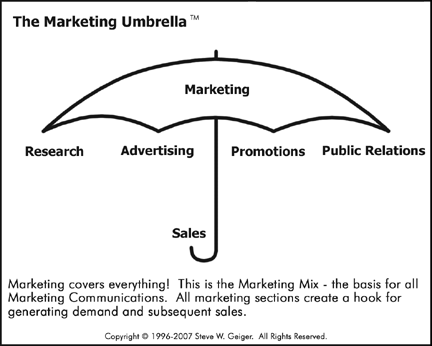
In Amy Nutt’s article “What is the Difference Between Marketing, Advertising and Public Relations?," she explains how public relations and advertising fall under the marketing umbrella.
image source: SteveGeiger.com

Nutt describes the company marketing plan as a comprehensive unit, one that brings the efforts of advertising and public relations into full realization.

“Marketing could be considered the whole ball of wax in this equation. A company's marketing department could be subdivided into several smaller sections that operate as separate entities, but all work toward the same ultimate goal - which is the success and growth of the company.”
-Amy Nutt

Marketing does in fact target more than just the consumer to reach this success, and it uses public relations and advertising to do so.

2. Public Relations


I ranked public relations as number two because boundaries between PR and marketing regularly overlap. Whether it is deciding which communication tools to utilize to reach the public, or how to deal with organization relationships, both have the same goal to maintain the success of the organization and its economic survival.

The department of public relations is used in a company to establish and maintain a favorable relationship with various publics such as consumers, stockholders, even employees. Brochures, events, press releases, and presentations are all tools used by PR practitioners to present information to numerous publics in hopes of earning trust and credibility for an organization.

3. Advertising

Advertising is a tool used by companies to promote their goods and services to external audiences through paid space and broadcast time. Companies look to the marketing department’s budget plan to dictate how much money can be used for advertising.

I placed advertising under public relations due to the large expense it can become. Placing an ad in a magazine can cost thousands of dollars, and television advertisements can cost in the millions. Companies see public relations as more cost-effective and more credible because, when earned, it appears in a news environment.

“Advertising and public relations may just seem like small pieces of the overall marketing puzzle, but without them the marketing plan could never fully be realized and the company's success would suffer accordingly.”
-Amy Nutt

Although advertising and public relations are integral components, the marketing department is the glue that binds them all together. Marketing gives these other entities direction and, as Nutt says, “ensures company growth and success.”

^d
Katie Keane

Press Room

The Keane Rapport


CONTACT INFORMATION:
Katie Keane
Blog Administrator
XXX-XXX-XXXX Office
XXX-XXX-XXXX Cell
KKeane2@gmail.com
TheKeaneRapport.blogspot.com


November 12, 2009

FOR IMMEDIATE RELEASE:

Establishing a Keen Rapport in Richmond

Blogs are taking the world by storm. For students, blogs have become helpful resources to new and exciting information. And as a public relations student, Katie Keane wanted to become part of the blogging community in hopes that some of her findings might be useful to others.

The Keane Rapport focuses mainly on the field of public relations. With so many different aspects, public relations is a trade with wide range of information. Keane wanted to focus on some of the most important facts and ideas about PR not only to learn more for herself, but also to help others who might be thinking about going into the field.

“Being a student in Richmond has helped a great deal with the launch of this blog,” Katie Keane said.

Being that Richmond is such a close community, blogs are used by most businesses. Ellwood Thompson uses theirs to announce sales and what their hot bar features that day, where Rumors uses theirs to let people know the latest threads that have been dropped off.

By the end of 2006, Technorati.com was tracking more than 55 million blogs In July 2006 the Pew Internet & American Life Project estimated that the US "blog population has grown to about 12 million American adults". Some might say that blogging is “leveling off,” however with its increasing use in businesses and education the numbers only continue to climb.

Add The Keane Rapport to the list, it won’t be going anywhere.


###

About The Keane Rapport
Created in the Fall of 2009, The Keane Rapport is a blog dedicated to the field of Public Relations. The Keane Rapport includes posts written from Katie Keane's, a student of PR, perspective and opinion that she derives from professionals' ideas and opinions.